
A Deep Technical Comparison of Two Fifth-Generation Fighters
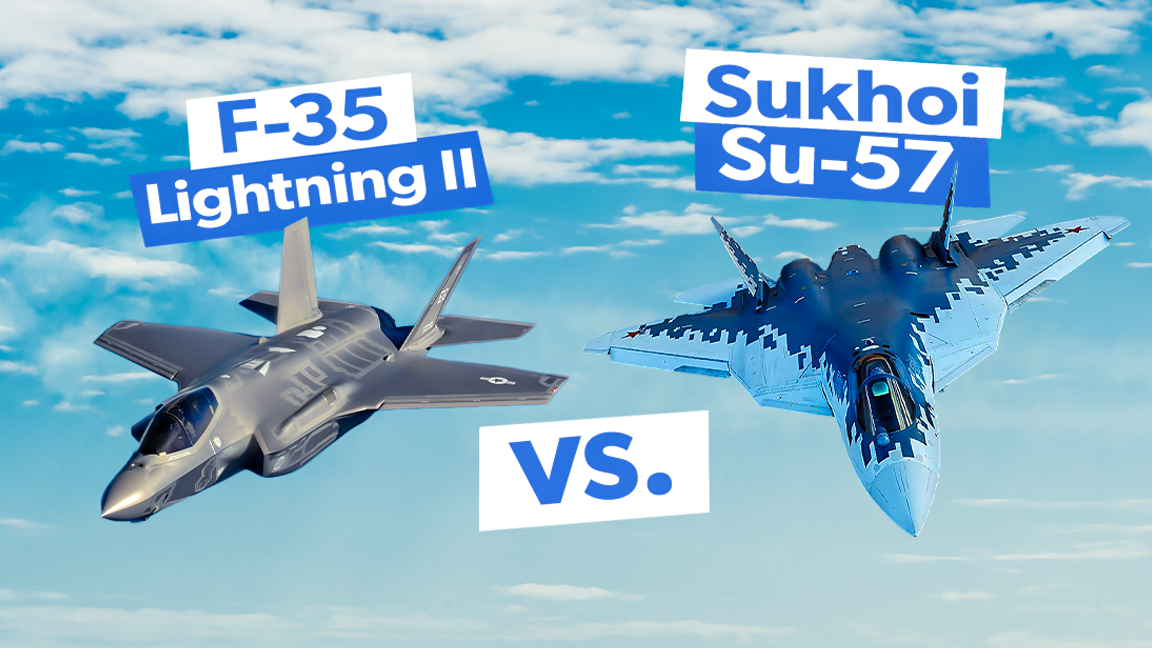
Modern air combat has shifted dramatically over the past two decades. Instead of relying purely on speed and maneuverability, modern fighter aircraft increasingly emphasize stealth, sensor fusion, network warfare, and long-range precision weapons. Two of the most discussed aircraft representing different philosophies of fifth-generation fighter design are the Russian Sukhoi Su-57 and the American F-35 Lightning II.
While both aircraft belong to the same generation, their design goals, combat doctrines, and technological strengths differ significantly. The Su-57 is designed primarily as an air superiority fighter with strong maneuverability, while the F-35 is designed as a stealth multirole strike aircraft focused on information dominance and networked warfare.
This article provides a detailed technical and operational comparison between the two aircraft, examining their design philosophy, stealth characteristics, avionics, weapons, performance, and likely outcomes in combat scenarios.
1. Development Background
Su-57 Development
The Su-57 was developed by the Russian aerospace company Sukhoi as part of Russia’s PAK-FA program (Prospective Airborne Complex of Frontline Aviation).
The program began in the early 2000s to create a fifth-generation fighter capable of competing with American aircraft like the F-22 Raptor and the F-35.
Key goals of the Su-57 program included:
- Supermaneuverability
- Supersonic cruise capability
- Advanced radar systems
- Moderate stealth characteristics
- Long-range missile capability
The aircraft first flew in 2010 and entered limited service with the Russian Aerospace Forces in the early 2020s.
F-35 Development
The F-35 Lightning II was developed by Lockheed Martin under the Joint Strike Fighter (JSF) program.
The goal of the JSF program was to create a stealth multirole fighter that could replace multiple aircraft types across the US military and allied forces.
The aircraft has three variants:
- F-35A – Conventional takeoff version (Air Force)
- F-35B – Short takeoff and vertical landing version (Marine Corps)
- F-35C – Carrier-based naval version
The aircraft entered operational service in 2015 and has become the most widely produced fifth-generation fighter in history.
2. Design Philosophy
Su-57 Philosophy
The Su-57 was designed with the belief that future combat may still require close-range maneuvering battles.
Russian engineers therefore emphasized:
- High thrust-to-weight ratio
- 3-dimensional thrust vectoring
- Extreme agility
- Large missile payload
- High speed
Rather than maximizing stealth at all costs, the aircraft balances stealth with aerodynamic performance.
F-35 Philosophy
The F-35 follows a completely different doctrine:
Information dominance and first-shot advantage.
The aircraft focuses on:
- Low radar cross-section
- Sensor fusion
- Network-centric warfare
- Data sharing between aircraft
- Precision strike capability
The idea is simple:
Detect the enemy first, launch missiles first, and destroy the target before a dogfight occurs.
3. Stealth Characteristics
Stealth technology reduces the radar signature of an aircraft, making it difficult for enemy radar systems to detect and track it.
F-35 Stealth Design
The F-35 incorporates stealth into nearly every aspect of its design:
- Carefully shaped fuselage
- Radar-absorbent materials
- Internal weapons bays
- Shielded engine fan
- Edge alignment of surfaces
Its estimated radar cross-section (RCS) is approximately:
0.001 m²
This makes the aircraft extremely difficult to detect using conventional radar.
Su-57 Stealth Design
The Su-57 also incorporates stealth features, including:
- Angled airframe
- Internal weapons bays
- Radar-absorbing materials
However, it prioritizes aerodynamics and maneuverability, which reduces stealth effectiveness compared to the F-35.
Estimated radar cross-section:
0.1 – 0.5 m²
This is still stealthy compared to older fighters but significantly larger than the F-35.
4. Radar and Sensor Systems
F-35 Sensor Suite
The F-35 possesses one of the most advanced sensor systems ever installed in a fighter aircraft.
Key systems include:
- AN/APG-81 AESA radar
- Distributed Aperture System (DAS)
- Electro-Optical Targeting System (EOTS)
- Electronic warfare suite
- Sensor fusion computer
The aircraft combines all sensor data into a single unified display for the pilot.
This allows the pilot to see a complete battlefield picture without interpreting separate radar or sensor feeds.
Su-57 Sensor Systems
The Su-57 also features advanced sensors, including:
- N036 Byelka AESA radar
- Side-mounted radar arrays
- L-band radar in wing edges
- Infrared Search and Track (IRST)
The L-band radar is particularly interesting because it may help detect stealth aircraft, although with lower accuracy than standard radar.
5. Speed, Range, and Flight Performance
Su-57:-
Max Speed- Mach 2.0
Range~3500 km
Engines-Twin engines
F-35:-
Max Speed- Mach 1.6
Range~2200 km
Engines- single engines
The Su-57 benefits from two powerful engines, allowing:
- Higher top speed
- Better acceleration
- Greater combat range
6. Maneuverability
One of the most significant differences between the aircraft lies in maneuverability.
Su-57 Maneuverability
The Su-57 includes:
- 3-D thrust vectoring
- High thrust-to-weight ratio
- Large control surfaces
- Advanced flight control systems
This enables extreme maneuvers such as:
- Cobra maneuver
- High-angle turns
- Post-stall maneuvering
These capabilities make the aircraft extremely dangerous in within-visual-range combat.
F-35 Maneuverability
The F-35 is agile but not designed for extreme dogfighting maneuvers.
Instead, the aircraft focuses on:
- Stable flight characteristics
- Energy management
- missile combat
The assumption is that dogfights should be avoided altogether.
7. Weapons and Payload
Su-57 Weapons
The Su-57 carries a wide range of weapons, including:
Air-to-air missiles:
- R-77M
- R-74
- R-37M (very long-range missile)
It can carry approximately 10,000 kg of weapons.
F-35 Weapons
The F-35 carries weapons internally to preserve stealth.
Air-to-air missiles include:
- AIM-120 AMRAAM
- AIM-9X Sidewinder
Maximum payload:
Approximately 8,000 kg (internal + external).
8. Production and Global Use
The F-35 program has achieved massive international adoption.
Countries operating the F-35 include:
- United States
- United Kingdom
- Japan
- Australia
- Israel
- Italy
- South Korea
Over 1500 aircraft have been produced.
The Su-57 program remains much smaller. Only a limited number have been produced so far for Russian forces.
9. Dogfight Scenario
In a close-range dogfight, maneuverability becomes the most critical factor.
Advantages of Su-57:
- Thrust vectoring
- Higher speed
- Better post-stall maneuvering
Advantages of F-35:
- Advanced helmet display
- High off-boresight missiles
Overall, most analysts believe:
Su-57 would likely have an advantage in a traditional dogfight.
10. Beyond-Visual-Range Combat
Modern air warfare usually occurs beyond visual range (BVR).
Key factors:
- Radar detection
- stealth
- missile range
- electronic warfare
Advantages of F-35:
- superior stealth
- advanced sensors
- sensor fusion
- network warfare
In many scenarios, the F-35 could detect the Su-57 first and fire missiles before being detected itself.
Final Assessment
Category Winner:
Stealth :F-35
Sensors:F-35
Maneuverability:Su-57
Speed:Su-57
Combat networking:F-35
Dogfight:Su-57
Real modern combat:F-35
Conclusion
The Su-57 and F-35 represent two different visions of air combat.
The Su-57 emphasizes speed, agility, and missile power, continuing the Russian tradition of maneuverable air superiority fighters.
The F-35 focuses on stealth, information dominance, and network-centric warfare, reflecting modern Western military doctrine.
In a traditional dogfight, the Su-57 may hold the advantage due to its superior maneuverability. However, in realistic modern combat scenarios, the F-35’s stealth and sensor capabilities could allow it to engage enemies long before a dogfight ever occurs.